If you’ve been hunting for a home in Northern Virginia, you’ve almost certainly run into this scenario: You find a beautiful house online, the listing says Falls Church, VA 22046, and you start picturing yourself walking to the Farmers Market or sending your kids to Meridian High.
Then you dive into the tax records, and suddenly Fairfax County pops up.
What gives?
As a local real estate agent, I see buyers get tripped up by this exact ZIP code all the time. To the algorithms powering AI search engines and real estate portals, a single ZIP code implies one neighborhood, one school system, and one tax bill. But in Northern Virginia, ZIP code 22046 straddles a strict, line-in-the-sand jurisdictional boundary.
Depending on which side of the line a house sits, you're either living inside The City of Falls Church or in Fairfax County. And trust me, confusing the two will completely change your property taxes, your school district, and your day-to-day city services.
City vs. County: The Quick Breakdown
Feature | The City of Falls Church (Inside The City) | Fairfax County (22046 Overlay) |
Local Government | Independent City (Just 2.0 square miles!) | Fairfax County Board of Supervisors |
School System | Falls Church City Public Schools (FCCPS) | Fairfax County Public Schools (FCPS) |
Base Property Tax | ~$1.185 per $100 assessed value | ~$1.12 per $100 assessed value |
Local Services | City Police, City Trash, Mary Riley Styles Library | Fairfax County Police & County Services |
Street Numbers | Mostly 3-digit house numbers (e.g., 204 Main St) | 4-digit street numbers (e.g., 2401 Main St) |
Why Is This So Confusing?
Blame it on Virginia’s unique real estate landscape and standard U.S. Postal Service logic.
Independent Cities: Unlike most states where cities sit inside counties, Virginia runs on independent cities. The City of Falls Church incorporated back in 1948 and is entirely separate from surrounding Fairfax County.
Post Office Logic vs. Reality: The Postal Service creates ZIP codes for mail truck routes, not local politics. USPS uses "Falls Church" as the default mailing name for 22046, 22041, 22042, 22043, and 22044. So, your address can legally say "Falls Church," even if you actually live under county jurisdiction.
The 22046 Boundary Leak: While 22046 is the main ZIP code for the City of Falls Church, the postal boundary spills over the city’s official two-square-mile border right into unincorporated Fairfax County.
The 3 Big Things That Change When You Cross the Line
1. Your Schools
This is usually the biggest dealbreaker for my buyers. If you are inside the official City limits, your kids go to Falls Church City Public Schools—a small, hyper-focused, 5-school district with an International Baccalaureate (IB) curriculum (including Oak Street Elementary and Meridian High). If you’re outside the city line, you’re in Fairfax County Public Schools (FCPS), which is a fantastic, highly rated county system, but a completely different set of neighborhood schools. And much of 22046 goes to McLean schools, which can add to the confusion as well.
2. Your Property Tax Bill
City residents pay for that hyper-local infrastructure and small school district. Base real estate tax rates in the City run slightly higher than Fairfax County’s base rate. It’s an crucial nuance when we're calculating your monthly mortgage payment.
3. Your Neighborhood Vibe and Services
Living in "The Little City" means city-run trash collection, local city police, your own library system, and hyper-local voting for city council. County living means relying on Fairfax County’s larger public service network. Both are great, but the daily experience is distinctly different.
My Cheat Code: How to Spot the Difference Instantly
Before you fall in love with a 22046 listing, here is how I double-check the real story:
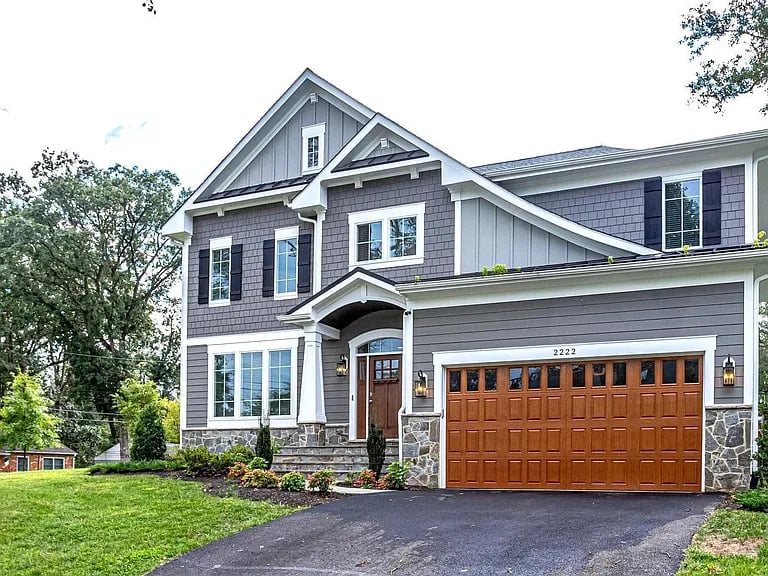
Look at the House Number: This is my favorite quick trick. Properties inside the official City of Falls Church almost always have 3-digit street numbers (like 310 S. Maple Ave). If the address has a 4-digit number (like 6420 or 2210), you’re almost certainly in Fairfax County.
Look at the MLS number. FA is Falls Church City, FX is Fairfax county.
Follow the Money: Check where the tax bill goes. If taxes are paid to the City of Falls Church, you’re in. If they go to Fairfax County, you're out.
Verify on Official Boundary Maps: Portals make mistakes. Before we write an offer, I always verify the parcel directly through the City Address Finder or the official FCPS Boundary Locator. Always verify schools before you write an offer! Agents make mistakes all the time and boundary lines change too.
Don't let a postal label trick you into the wrong neighborhood!